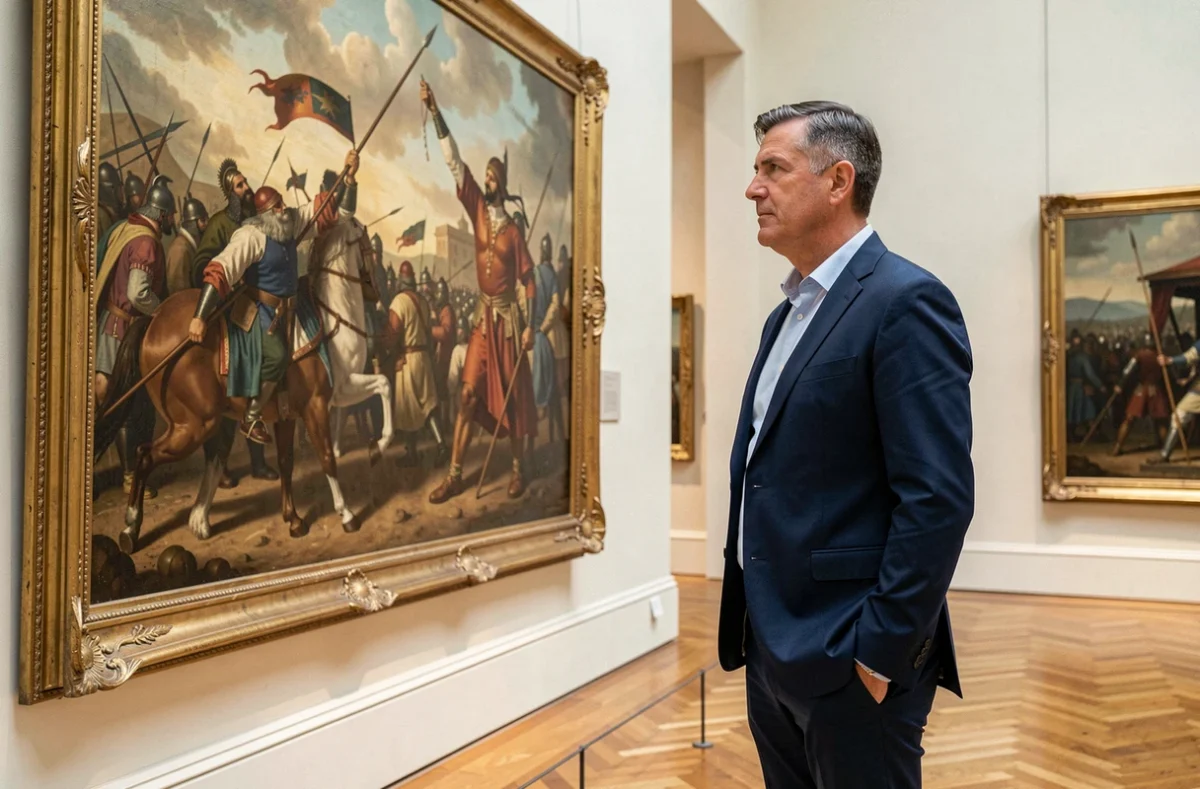
Among the collections of the Louvre, several hundred works document episodes of military conquest. Monumental paintings, ancient bas-reliefs, art objects: these pieces capture power dynamics, transfers of authority, territorial breaks. Comparing their periods, formats, and patrons allows us to measure how the representation of war has evolved over several centuries within the same museum.
Military Conquest at the Louvre: Works Spanning More Than Twenty Centuries
The uniqueness of the Louvre lies in the chronological breadth of its collections related to war. Mesopotamian steles celebrating Assyrian victories coexist with 19th-century canvases commissioned by the French state. This temporal gap radically alters the function of the work: an Akkadian relief served as royal propaganda in a palace, while a painting by Delacroix or Gros targeted a Parisian Salon audience.
| Period | Type of Work at the Louvre | Original Function |
|---|---|---|
| Mesopotamian Antiquity | Steles, palace bas-reliefs | Royal propaganda, votive offering |
| Greco-Roman Antiquity | Sculpted sarcophagi, ceramics | Funeral commemoration, mythological narrative |
| Middle Ages and Renaissance | Art objects, illuminations | Dynastic glorification |
| 17th-18th Century | Large gallery paintings | Monarchical commission, palace decoration |
| 19th Century | Monumental canvases | State commission, public exhibition at the Salon |
This table shows that military conquest changes its medium depending on the patron. War is not narrated in the same way on an Assyrian relief meant to impress ambassadors and on a several-meter canvas hung in a gallery open to the public.
To delve deeper into how inventory sheets provide insight into the history of these pieces, one can consult the Louvre inventory article on Must Paris, which details the link between cataloged notices and thematic pathways in the museum.
Battle Paintings at the Louvre: What the Format Reveals About Power
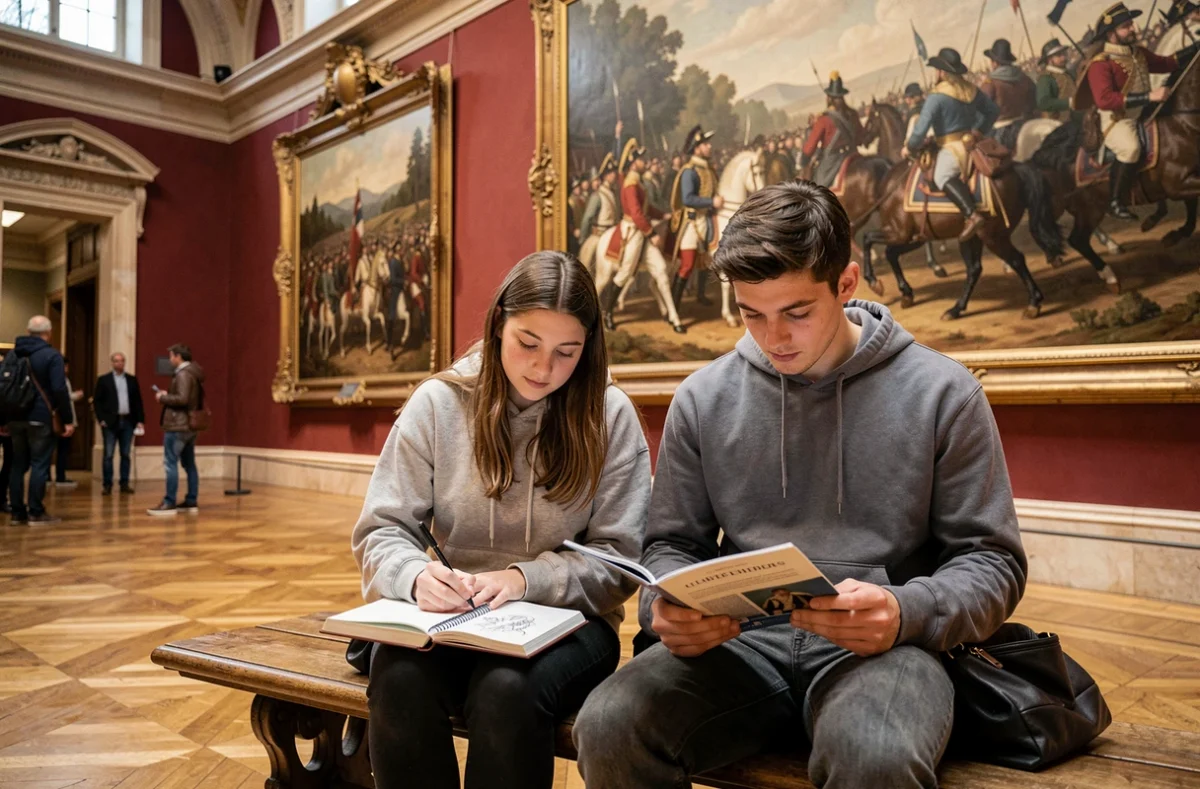
The French painting rooms concentrate the most spectacular representations of conquests. Their common point: monumental dimensions. The canvases often exceed several meters in width, a format dictated by their destination (royal galleries, ceilings, state rooms).
Antoine-Jean Gros, with his scenes of Napoleonic campaigns, or Eugène Delacroix, with the Capture of Constantinople by the Crusaders, illustrate two distinct approaches to painted war. Gros places the military leader at the center of the composition, in direct interaction with the vanquished or the wounded. Delacroix shifts the focus to the collective chaos, the falling city, the civilians.
The Political Commission Behind Each Canvas
Each battle painting responds to a specific commission, and this commission guides the narrative. Under Louis XIV, battle painters worked for the decorations of Versailles or royal residences. The goal was dynastic: to showcase the king’s power through the victory of his armies.
In the 19th century, the commission shifted towards the Salons and museums. The state purchased or commissioned canvases for the Luxembourg Museum, then for the Louvre. The recipient was no longer the king in his palace, but the Parisian public. This change in audience alters the narrative: the suffering of the vanquished becomes a legitimate subject, where it was previously minimized.
Oriental Antiquities: Conquest Before Painting
The departments of Oriental antiquities at the Louvre house pieces that document war long before the invention of easel painting. The Assyrian reliefs from the palaces of Nineveh or Khorsabad depict sieges of cities, deportations of populations, tributes imposed on subjugated peoples.
- The reliefs from Khorsabad (8th century BC) detail the campaigns of Sargon II with near-cartographic precision: fortifications, siege engines, columns of prisoners
- The victory stele of Naram-Sin celebrates an Akkadian victory through a vertical composition where the king physically dominates his enemies, a visual code repeated for millennia
- The winged bulls (lamassu) that guarded the entrances of Assyrian palaces do not represent a specific battle, but embody military power as a permanent attribute of authority
These objects do not narrate war as an event, but as a state. Conquest is presented as a natural function of the sovereign, not as a historical rupture. This difference in conception fundamentally distinguishes Oriental antiquities from European paintings at the Louvre.
Mamluks and Ottomans at the Louvre: Conquest Seen from the Other Side
The Louvre hosted an exhibition on the Mamluks, tracing their power in Egypt from their victory over the Mongols in 1260 to their defeat by the Ottomans in 1517. This historical sequence, later presented at the Louvre Abu Dhabi, offered a direct counterpoint to narratives centered on European conquests.
The collections of the Louvre allow us to read conquest from multiple camps, not just that of the Western victor. The weapons, textiles, and Islamic art objects displayed in the dedicated rooms testify to autonomous military traditions, with their own codes of representation of power.
A Sequential Reading Rather Than Isolated Battles
The Mamluk exhibition explicitly linked the rise to power, military victory, and political downfall. This sequential approach contrasts with the European tradition of “battle painting” centered on a single moment. A thematic pathway at the Louvre benefits from adopting this logic: following transfers of domination rather than collecting heroic scenes.
The online catalog of the Louvre notes that, since the overhaul of its management tools, some locations of displayed works may not be up to date. Before constructing an itinerary around military conquest, checking the display on-site remains the most reliable precaution.
The collections related to the museum’s military history span several departments (paintings, Oriental antiquities, Islamic arts, art objects), which necessitates crossing the wings of the palace rather than following a linear path.