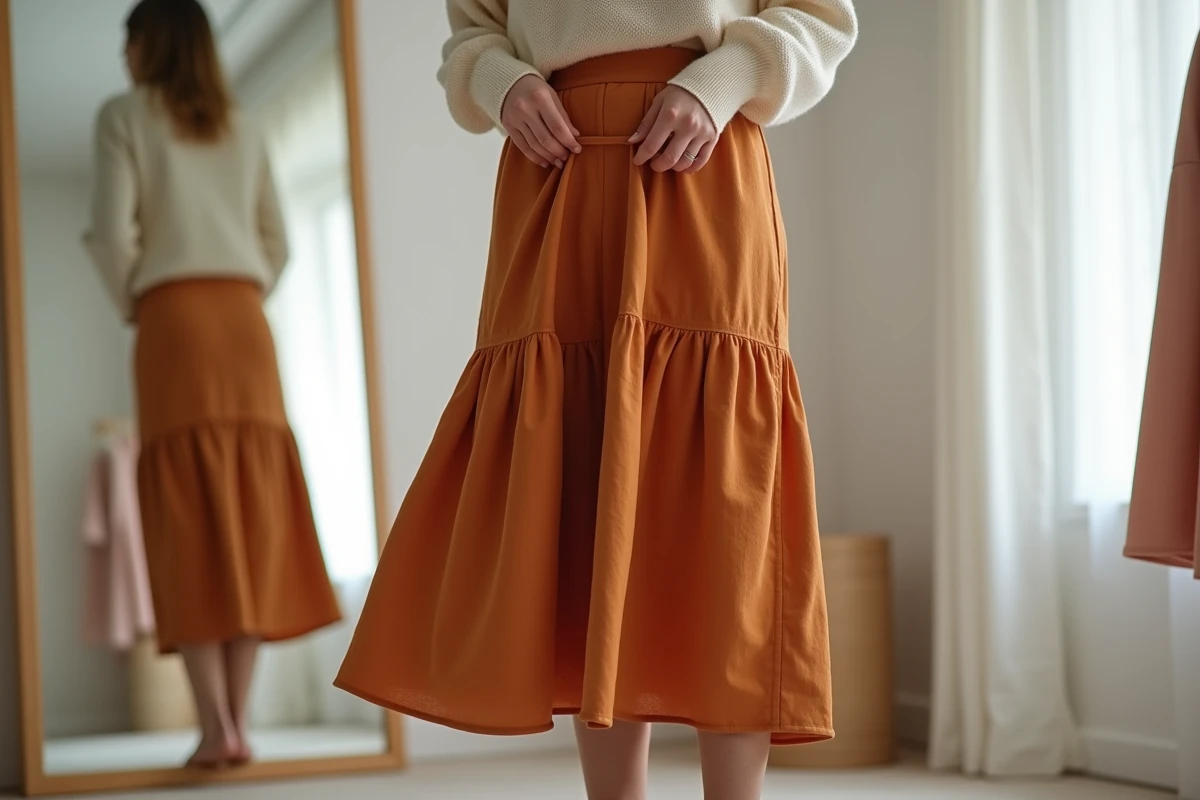
A long skirt bought online fits perfectly on the model, but once worn, it drags on the ground or cuts the silhouette at the wrong spot. The problem rarely lies with the model itself. It comes from the exact place where the hem stops on your body, and that spot changes according to your proportions, your shoes, and your way of moving.
The hem at the narrow point of the ankle: the marker that changes everything
Most fashion guides categorize women by letters (A, V, H, X) and then recommend a length. This approach overlooks a detail that tailors know well: the placement of the hem at a narrow point on the leg matters more than the overall body shape.
Specifically, the ankle has a narrower area, just above the prominent bone. When the hem falls exactly at that spot, it creates a visual lightness effect. A few centimeters lower, the skirt weighs down. A few centimeters higher, it can cut across the calf at its widest point and thicken the leg.
Alteration workshops in France have also noticed an increase in requests to shorten long skirts by just a few centimeters, including from petite women. The goal is not to shorten for the sake of shortening, but to precisely reveal the narrowest point of the ankle. This practical reflex contradicts the common belief that petite women should avoid very long skirts. With a well-placed hem, the long skirt works for all sizes.
If you want to know everything about skirt length before placing an order or having a model altered, this ankle marker is the first criterion to keep in mind.

Long skirt and body shape in motion: testing the length in real situations
Have you ever noticed that a skirt looks perfect in front of the mirror, but feels awkward as soon as you walk or sit down? That’s because length is judged statically in fitting rooms, while you live dynamically.
Why heel height alters perceived length
The same long skirt can break the silhouette with flat shoes and become very flattering with a medium heel. The difference of a few centimeters at the foot changes the entire line. If you usually wear sneakers or flat sandals, the skirt needs to be shorter than if you plan to wear heeled ankle boots.
Choose your skirt while wearing the shoes you will actually pair it with. This may seem obvious, but most fittings are done barefoot or in socks, which completely skews the result.
Three movements to do in the fitting room
Before finalizing a model, test these real-life situations:
- Walk several meters and check that the hem does not brush the ground or rise too high on the calf with each step.
- Sit down and observe where the fabric positions itself: a flowy skirt will rise slightly, a structured skirt will crease at the thighs.
- Step up a few stairs (or simulate the action) to ensure you are not stepping on the fabric when lifting your foot.
These tests take thirty seconds and prevent many disappointments. Image coaching training emphasizes this functional aspect, while classic recommendations are limited to the aesthetic result standing in front of the mirror.
Adapting the length of a long skirt to your torso-leg proportions
The body shape in letters (A, V, H, X, O) describes the distribution of body volumes from the front. But for a long skirt, what matters most is the ratio between the length of the torso and that of the legs.
A woman with a long torso and short legs does not need the same length as a woman with the opposite proportions, even if they are the same height and wear the same body shape letter.
Long torso, short legs
The goal is not to further compress the lower body. A skirt that stops at mid-calf (high midi length) or just above the ankle works well. Paired with a high waist and a tucked-in top, it creates a higher waistline that balances the silhouette.
Short torso, long legs
You have more freedom regarding length. A maxi skirt that brushes the ground remains proportionate because your legs compensate for the height of the fabric. However, be careful with the material: too rigid a fabric on a very long skirt creates a cardboard effect that negates natural fluidity.
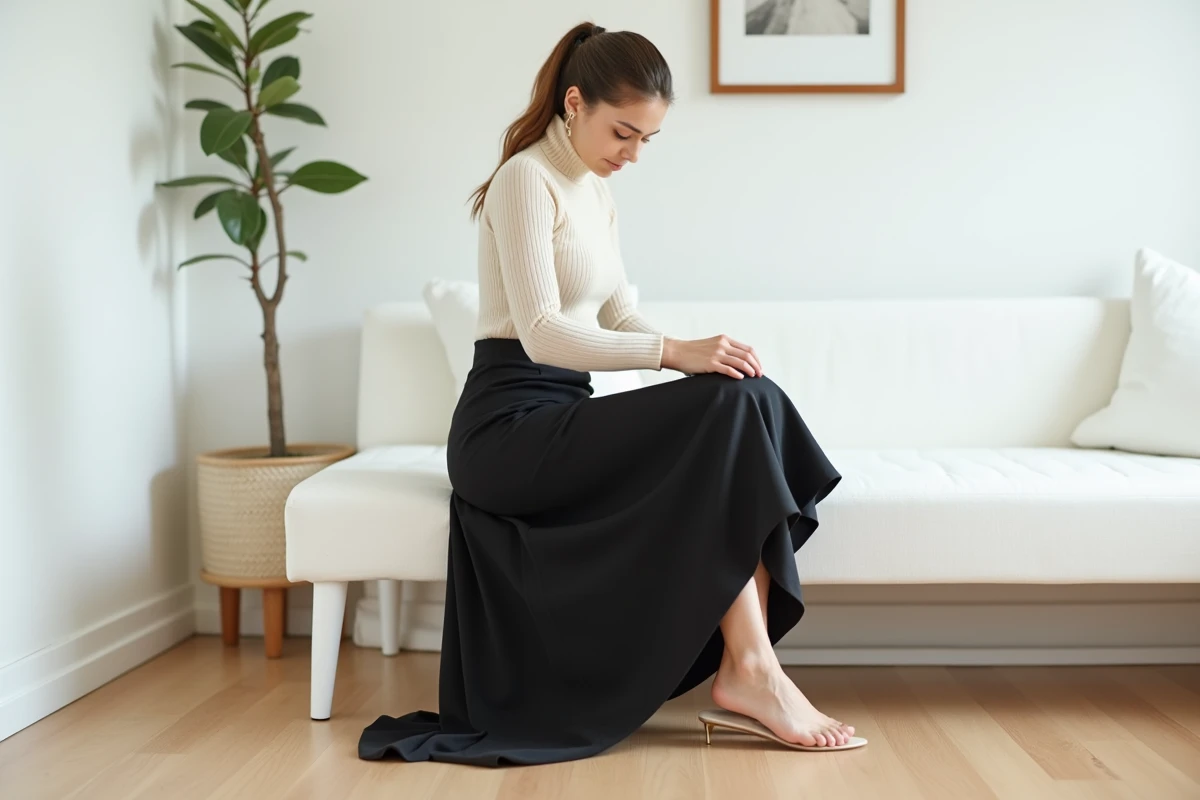
Fabrics and cut: the two variables that modify perceived length
Two long skirts of the same length in centimeters can give a very different impression depending on their fabric and cut.
A flowy fabric (viscose, crepe, lightweight jersey) follows movement and falls naturally downwards. It visually elongates the silhouette. A structured fabric (thick denim, rigid cotton, leather) maintains its shape and can shorten the visual effect because it does not follow the line of the body.
The flared cut (like a long trapeze or skater skirt) adds lateral volume. If you are looking to elongate the silhouette, a straight or slightly flared cut from the knee will be more effective than a very wide cut from the waist.
Here are the combinations to remember:
- To elongate the silhouette: flowy fabric, straight or slightly flared cut, dark solid color.
- To accentuate the waist without thickening the hips: soft fabric wrap skirt, midi to ankle length.
- To create movement without losing structure: pleated skirt in lightweight fabric, hem above the ankle.
- For a casual everyday look: jersey or linen, straight cut, length adjusted with the shoes of the day.
The choice of a long skirt’s length is not limited to a fixed morphological grid. It is the alignment between the hem, the shoe, the fabric, and your actual proportions that produces the result. Get into the habit of testing in motion, with your usual shoes, and focus on that famous narrow point of the ankle. This simple marker is worth all the body shape charts.