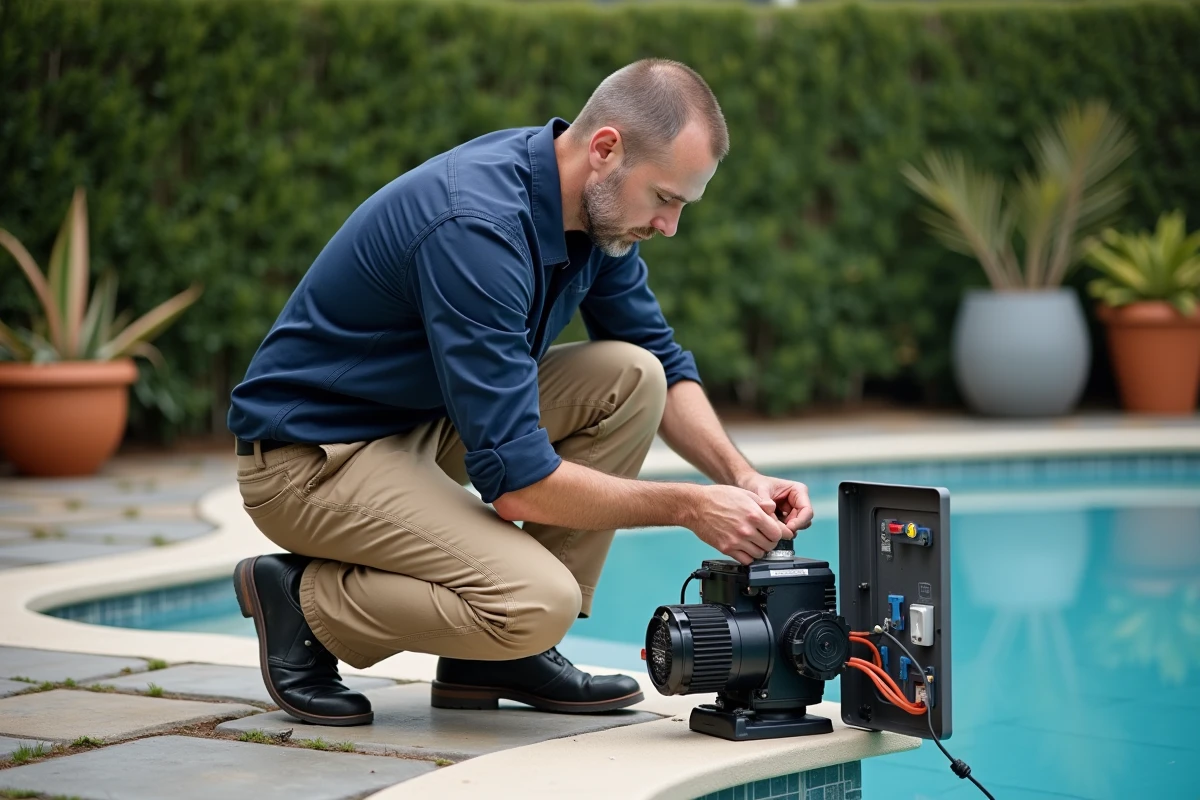
A filtration pump that trips in the middle of summer, a warm cable to the touch after a few hours of operation: these situations occur in installations where the cable size has been chosen lightly. The problem almost never comes from the pump itself, but from the wire that powers it. Properly sizing this cable protects the motor, avoids energy losses, and complies with the NF C 15-100 standard.
Voltage drop over long distances: the trap of remote technical rooms
On paper, connecting a technical room located a few meters from the electrical panel poses no difficulty. The reality on the ground is different: many pools are installed at the back of the garden, with cable distances easily exceeding thirty meters.
The longer the cable, the more the resistance of the conductor causes a voltage drop. The pump motor then receives a voltage lower than its nominal voltage. It compensates by drawing more current, which heats the cable and reduces the motor’s lifespan.
To delve deeper into the issue of effective pool pump power cable sizing, it should be noted that the standard requires maintaining the voltage drop below an acceptable threshold (often around 3% at the end of the line for a final circuit). In practice, beyond 25 meters, it is often necessary to move up to the next size compared to what the nominal current alone would require.
Example of reasoning on the ground
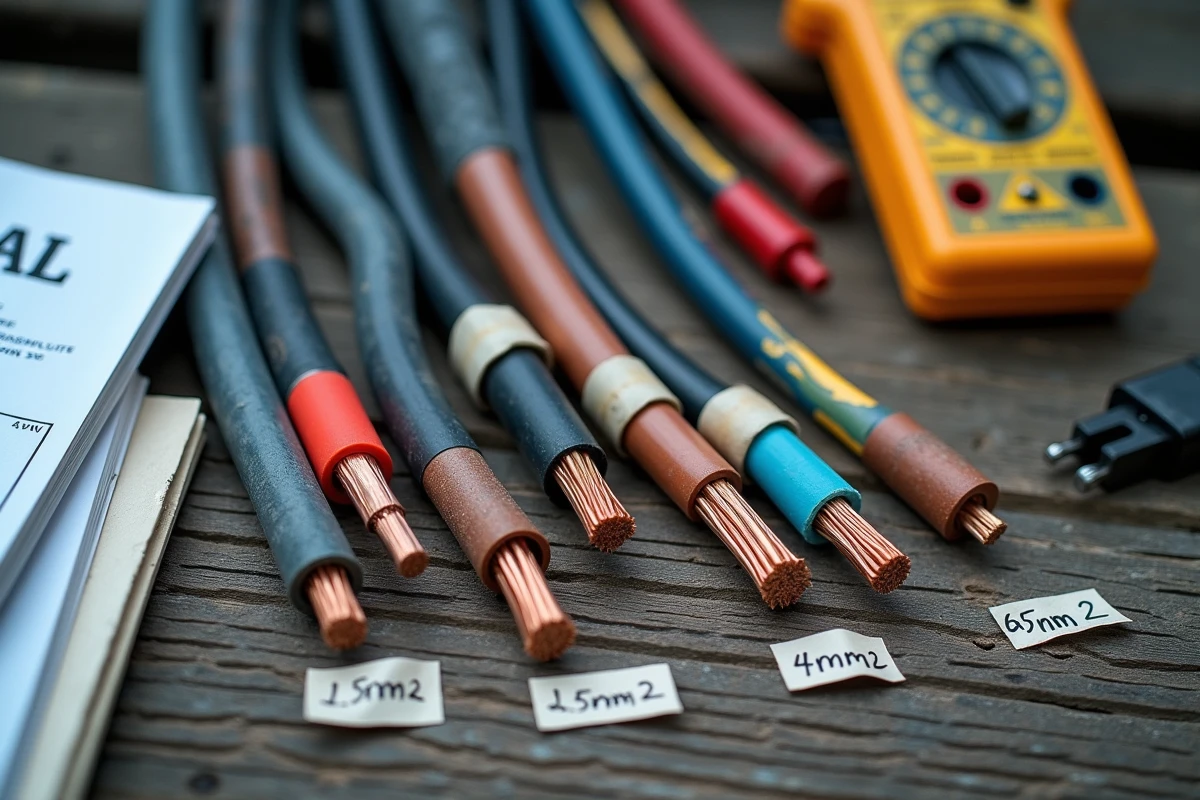
We have a single-phase filtration pump that consumes a few amps at 230 V, and the technical room is located 40 meters from the panel. If we settle for the minimum size provided for the current, the voltage drop exceeds the tolerated threshold. Moving from a 2.5 mm² section to 4 mm², or even 6 mm², brings the voltage drop back within acceptable limits.
Feedback varies on this point: some electricians systematically increase the size as soon as the length exceeds 20 meters, while others calculate as precisely as possible. A safety margin is always preferable when burying a cable that won’t be unearthed anytime soon.
Cable size and protection at the panel: the duo that should not be separated
Choosing the right size without adapting the differential protection and the associated circuit breaker makes no sense. Both should be sized together.
- The circuit breaker must be calibrated based on the motor’s maximum current, not just its nominal power (the starting current of a pump can be several times higher than the running current).
- A 30 mA type A or AC differential is mandatory on the pool circuit according to NF C 15-100, as we work in close proximity to water.
- The cable size must be compatible with the circuit breaker rating: a 2.5 mm² cable is protected by a maximum 20 A circuit breaker, while a 6 mm² cable can handle a circuit breaker up to 32 A.
Neglecting this consistency exposes you to two risks: a circuit breaker that trips without apparent reason (undersized relative to current demands) or, worse, a cable that overheats because the circuit breaker is too large for the installed size.
Buried rigid cable or exposed flexible cable: which type for the pool circuit
The choice of cable type depends on the route between the panel and the technical room. Two configurations are common in most installations.
Buried route in the garden
For a cable that runs in a trench, a R2V type cable (rigid, PVC insulated) is used. It is laid in TPC sheath (red or black corrugated tube) buried at a minimum depth of 50 cm under a non-trafficable area. This cable withstands soil moisture well and offers good longevity.
Armored cables (type AR2V) are starting to be recommended in some recent technical guides for pool environments, thanks to their enhanced mechanical and chemical protection. Their additional cost remains moderate compared to the total length of the circuit.
Exposed route in the technical room
Inside the technical room, a flexible H07RN-F type cable is suitable for the final connection of the pump. This cable withstands motor vibrations and resists ambient humidity. It should be run in a duct or cable tray fixed to the wall, never placed on the ground in an area that could be flooded.

Variable speed pump: a sizing that changes the game
Variable speed pumps equipped with electronic controllers are becoming widespread. They reduce energy consumption, but their electrical behavior differs from that of a conventional pump.
A speed controller generates harmonics on the network, which can cause additional heating of the cable. The current measured in steady state is lower than with a single-speed pump, but transient current peaks can sometimes be more pronounced.
On the ground, it is observed that the size calculated for a conventional pump of the same power generally suffices, provided that it has not been undersized. If the cable is already long, it is better to plan for a slightly larger size to absorb these constraints without risk margin.
The associated circuit breaker must also be compatible with the characteristics of the controller. Some pump manufacturers recommend a D curve circuit breaker (rather than a C curve) to handle current demands without unwanted tripping.
Checks before powering up the pool circuit
Before closing the panel and starting the pump, a few checks are necessary:
- Check the continuity of the ground conductor along its entire length, from the panel to the pump’s ground terminal.
- Ensure that the cable has not been damaged during trenching (a simple sharp stone is enough to cut the sheath).
- Check the tightness of the connections at the panel and at the pump terminal: a poorly tightened contact causes localized heating, the primary cause of fire in power circuits.
- Measure the insulation of the cable using a megohmmeter if the length exceeds a few dozen meters.
A well-sized and properly installed pool circuit requires almost no maintenance afterward. The buried cable will last as long as the pool itself, provided it was selected with the right size from the start and protected by a circuit breaker suited to the actual configuration of the installation.