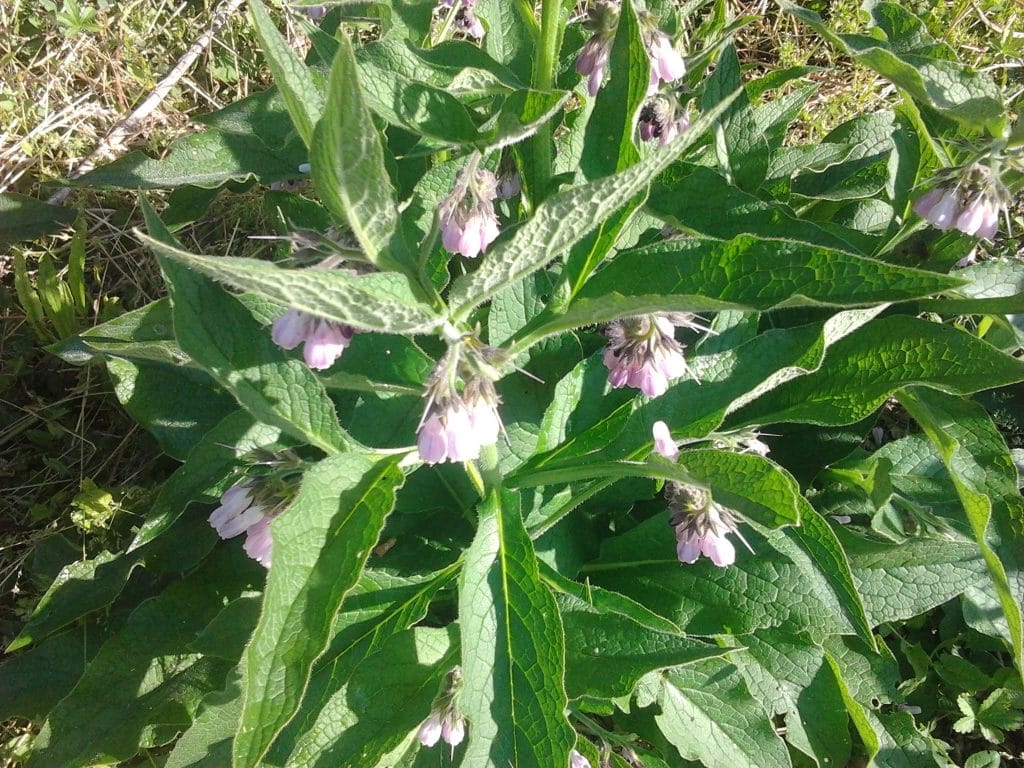
Comfrey is still too little known. However, its virtues are numerous.
I also believe that every permaculture gardener should grow comfrey, a plant that is always useful in a natural garden.
Rather, judge:
- The fertilizing power of comfrey fertilizer is higher than good compost;
- Strengthen the natural defenses of plants by revitalizing them;
- Helps in the healing of injured tissues .
- Bees love it (long flowering from May to October).
Introduction to Comfrey

Bocking 14 Comfrey Plant Bloom There are several varieties of comfrey.
Some are hybrids, others are spontaneous varieties.
Contrary to what I usually claim, regarding comfrey, I strongly recommend growing a hybrid variety, namely Russian comfrey.
Russian Comfrey
The Russian comfrey (Symphytum Peregrinum) is the result of a cross between the spontaneous comfrey of Western Europe (Symphytum officinale) and its eastern cousin (Symphytum Asperum).
It is a sterile hybrid plant that does not produce seeds (an advantage compared to common comfrey… as you will see in the following lines — but of course, you will not find Russian comfrey seeds to sow).
It is particularly rich in potash (up to 14% for Bocking 14 comfrey).
Russian comfrey forms imposing clumps measuring nearly 2m in height.
Its foliage is very dense.
Russian comfrey is the most used by gardeners.
Common Comfrey (Symphytum officinale)
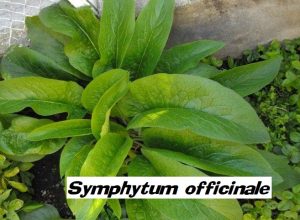
Common Comfrey (Symphytum officinale Comfrey (Symphytum_Officinale)) is spontaneous (for this reason it is also commonly called wild comfrey) in Europe, particularly in wet areas (near rivers, streams, canals, ditches, or wet meadows) and heavy soils.
The flowers of common comfrey, in the shape of bells, can be pink, purple, or white (leaning towards yellowish). Its leaves are large, broad, and slightly hairy.
Common comfrey is less rich in fertilizer than Russian comfrey, but still contains calcium, potassium, phosphorus, and vitamins A and C, and especially B12.
It can therefore also be used in the garden.
But beware of its proliferation in the garden (unlike Bocking 14 comfrey, which is sterile and does not produce seeds, common comfrey grows naturally through spontaneous planting… and a garden could soon be completely colonized by this invasive plant.
Comfrey Composition
Comfrey contains mucilages, alkaloids, vitamins, minerals, potassium, phosphorus, organic nitrogen, essential oil…
Growing Comfrey
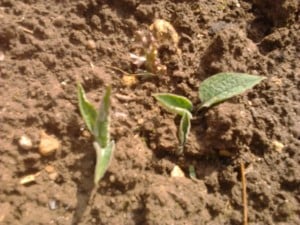
Position: March 26, 2013: My 14 comfrey cuttings, planted in the fall, are finally coming out of the ground. Comfrey is a very vigorous perennial plant that establishes itself very easily. We will then reserve a spot at the edge of a vegetable garden. It particularly appreciates moist, rich soils and a sunny location.
Propagation: Comfrey propagates easily by root or stem cuttings torn with a small piece of root. Cuttings can be planted from mid-February to November at least 70 cm in all directions.
Using Comfrey in the Garden
Fertilization:
Its richness in nitrogen, phosphorus, organic potassium, and the wide variety of mineral elements it contains (boron, copper, iron, manganese, zinc…) makes comfrey an ideal plant for fertilizing most vegetables.
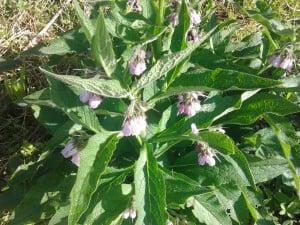
Comfrey in bloom in May 2014 Its remarkable biomass allows for up to 4 cuts per year. Starting in May, its foliage will be used as ground cover (mulch) for greedy crops.
This mulch will then be lightly incorporated into the soil, providing a choice of food for our cultivated plants.
Just like with nettles, we can also place a handful of comfrey leaves at the bottom of the planting hole for tomatoes.
The last cut in autumn will enrich the compost or will simply be left at the foot of the comfrey plant.
Revitalization:
Its richness in vitamins and minerals gives it unprecedented revitalizing power.
Deficient plants (especially in nitrogen or potassium) can be effectively treated with a diluted comfrey decoction at 5%.
Regular watering at the base with a diluted comfrey fertilizer at 10% will promote the growth of greedy vegetables and strengthen their natural defenses.
Healing:
As its name suggests, it consolidates “soda.” It is then capable of regenerating and supporting the healing of damaged tissues.
Spray 5% diluted comfrey fertilizer on a plant… and wait for the miracle to work.
Comfrey Purine and Decoction Preparations.
For purines as well as decoctions, the whole fresh plant (leaves, stems, flowers) is used except for the roots in the proportion of 1 kg of plant for 10 liters of water.
Comfrey Fertilizer
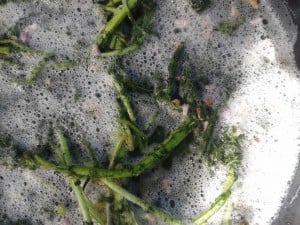 this foam, you must wait to use this comfrey purine…
- Fill a container (in soil, wood, or plastic, but in no case metallic) with fresh plants (leaves and flowering stems)
- Fill with rainwater.
- Cover with light ventilation.
- Stir every day: you may observe foam forming on the surface. The manure is ready to use when there is no foam (1 or 2 weeks).
- Filter
- Dilute the comfrey manure to 5% for spraying and 10% for watering at the base of the plants
The Comfrey Decoction
- Soak fresh plants (100 g for 1 liter of water) for 24 hours
- Then bring to a boil for 20 minutes
- Cover and let cool
- Filter before spraying (dilution of 5%)
For me, comfrey is the essential plant in a permaculture garden.
Try it, you will be amazed by its benefits.
Not to mention its medicinal virtues: astringent, healing, revitalizing…
Where can I find Bocking 14 Comfrey?
B-ACTIF is a Breton company producing comfrey and particularly marketing root cuttings of Bocking 14 comfrey.
Certainly, the purchase price seems a bit high (after all, they are just fragments of roots), but you can then easily cut the comfrey and then multiply it infinitely, thus having free fertilizer for life…
You can also find ready comfrey manure here.
Watch my comfrey training video in the garden.
Tag: bocking 14 comfrey