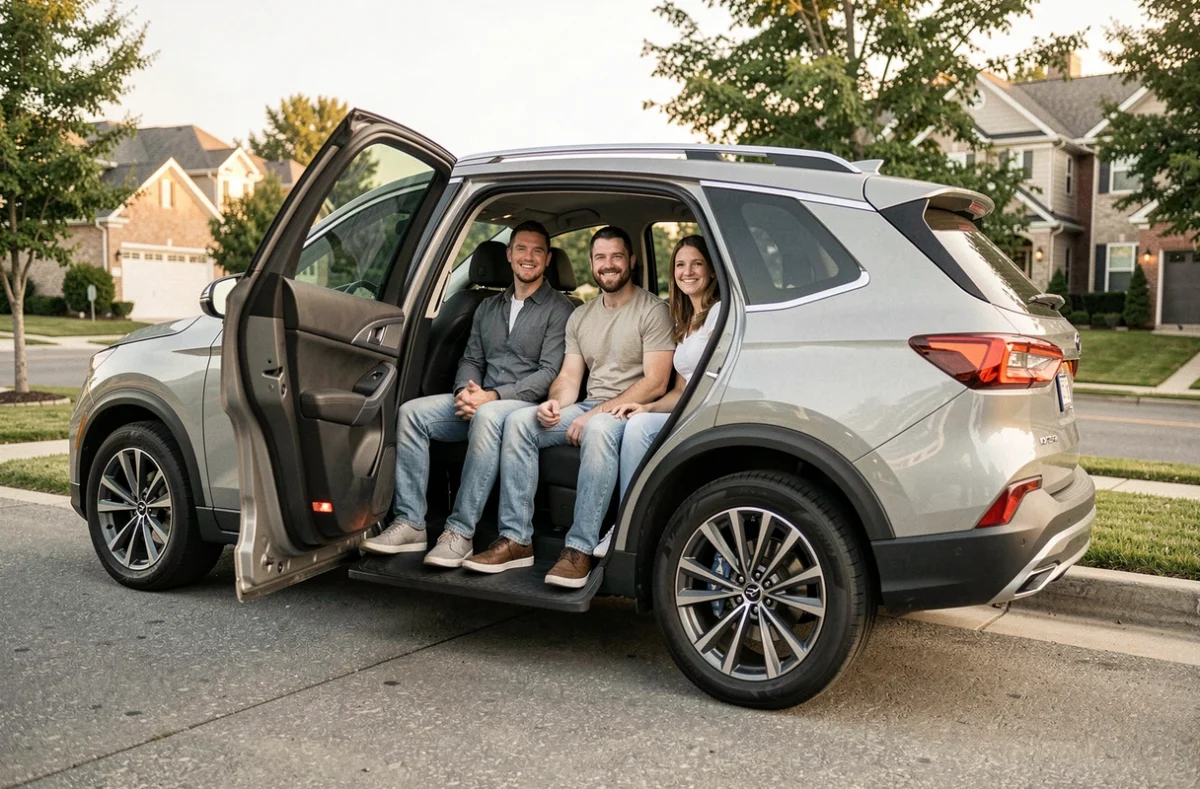
Fitting three car seats side by side on an SUV’s rear bench remains one of the most practical challenges for families with three children. The deciding factor is neither engine power nor boot capacity, but the usable width between the door trims at elbow level. This guide compares SUVs on this measurement and on the actual number of Isofix anchor points—two details rarely considered together in technical specifications.
Elbow room and Isofix anchor points: SUV comparison table
Elbow room determines whether three seats can fit side by side. But a wide cabin alone is not enough: you also need to check how many Isofix anchor points are available in the second row. Most SUVs have only two, on the outer seats; the centre seat must be secured with a seat belt if the manual allows it.
| Model | Segment | Isofix anchor points (row 2) | Rear bench split | Notes |
|---|---|---|---|---|
| Peugeot 5008 (2024-2026) | Family SUV | 2 outer + centre seat belt fitting | 40/20/40 | Three individual seats, narrow centre seat |
| Renault Espace (2025) | Family SUV | 2 outer + centre seat belt fitting | 40/20/40 | Generous headroom, almost flat floor |
| Skoda Kodiaq | Family SUV | 2 outer | 40/20/40 | Optional third row, spacious second row |
| Citroën C5 Aircross | Compact SUV | 2 outer | 40/20/40 | Three individual sliding seats |
| Kia Sportage | Compact SUV | 2 outer | 60/40 | Decent width, prominent centre tunnel |
| Renault Austral | Compact SUV | 2 outer | 40/20/40 | Longitudinal sliding seats, flexible boot |
A 40/20/40 split means three separate seats, making it easier to fit car seats than a 60/40 layout, where the centre seat shares its structure with one of the outer seats.
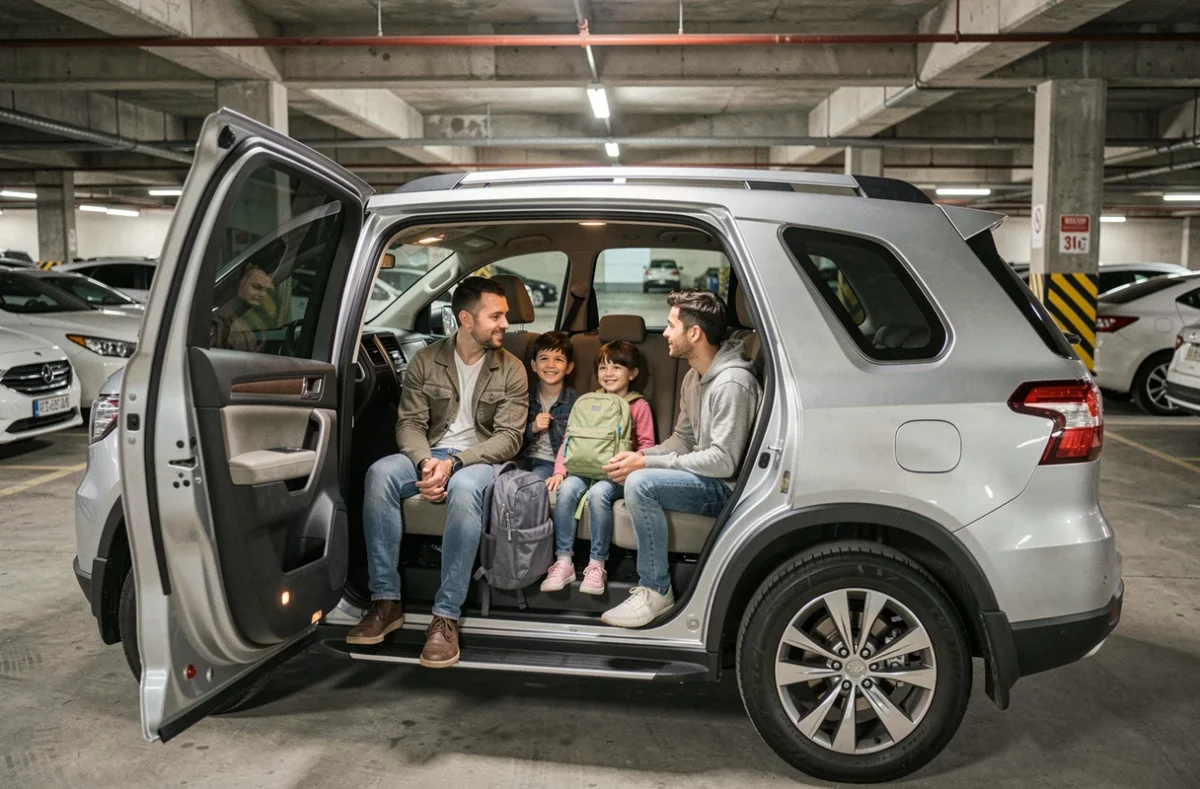
Families looking for an SUV with 3 proper rear seats should check the exact compatibility between their car seat models and the rear bench, as a difference of just a few centimetres between two SUVs can make all the difference.
R129 standard and real-world compatibility of three car seats
Since September 2024, new car seats have had to meet the R129 (i-Size) standard. R44 models, which are more compact, can still be used as long as they are in good condition, but they are no longer sold. This regulatory change has a direct impact on fitting three seats side by side.
R129 infant carriers and car seats often have a more enveloping shape, with bulkier side-impact protection. A setup that worked with three R44 seats may no longer be possible with R129 models. Test-fitting the seats you actually use before buying the vehicle helps avoid unpleasant surprises.
- Check both the car seat and vehicle manuals to confirm that belt installation is approved for the centre seat, as Isofix is rarely available there.
- Measure the actual footprint of the R129 seat once installed, with the side-impact protection extended—not folded away as it may be in the shop.
- Test all three seats at the same time: two outer seats may fit individually but clash with the third seat in the centre.
The Peugeot 5008 and Renault Espace, with their three individual second-row seats, have a structural advantage here. Separate seats leave a small gap between each car seat, unlike a one-piece bench.
Seven-seat SUVs and five-seat SUVs: two different answers to the same need
Some families consider a seven-seat SUV as a solution. The logic seems simple: split the children between the second and third rows. In practice, however, there are other constraints.
In most seven-seat SUVs, the third row is designed for older children or short journeys. Access is often awkward, and fitting a harnessed car seat in the third row may be impossible because there are no suitable anchor points or not enough room to fasten the seat belt around the seat.
A five-seat SUV with a genuinely wide rear bench (three individual seats, 40/20/40 split) is better suited to everyday use than a seven-seater where only two seats can accommodate car seats. The Skoda Kodiaq illustrates this distinction well: its optional third row can accommodate an adult for a short journey, while the second row remains the practical choice for families with three young children.

What to consider beyond the rear bench: boot, doors and floor
Rear bench width is only part of the problem. Three children in car seats also means handling three seats regularly.
- Sliding doors on MPVs (Citroën Berlingo, Peugeot Rifter) open much wider than conventional SUV doors, making it easier to fit seats on the outer positions.
- A flat floor in the second row makes it easier to move from one seat to another without having to step over a transmission tunnel.
- Usable boot space drops significantly when three car seats are installed and the seatbacks can no longer be folded down, so start with a generous boot.
The Citroën C5 Aircross has individual sliding seats, allowing you to adjust the balance between legroom and boot space. The Renault Austral offers similar sliding adjustment. These features partly make up for a standard-sized boot.
The choice between an SUV and an MPV often comes down to a trade-off between a higher driving position and easy rear access. SUVs appeal with their elevated seating position and versatility, but MPVs are still better for accessing car seats thanks to their sliding doors. For a family whose top priority is fitting and removing three seats every day, this difference matters just as much as rear bench width.